Gossip and social reputation
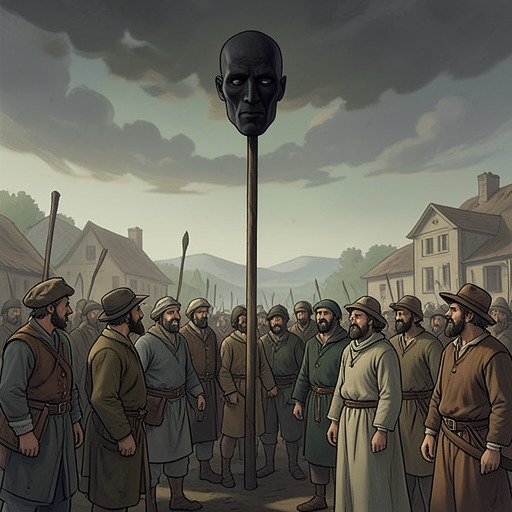
The PeasantsIn Lipce, gossip is more than idle talk: it is a way the village produces and polices reputations. Reports about private conduct travel through homes and gatherings, meet with suspicion or relish, and can shape how people are treated before their truth is settled. Boryna’s efforts to head off talk about his marriage and Jagna’s shame at being discussed show how reputation becomes a force within the household as well as the wider community.
Reputation and the limits of self-defence
After a drunken episode at the inn, Boryna visits houses around the village and brings up the incident himself, presenting it as a joke and recounting how drunk he had been and how he fell ill. The villagers are surprised, but his explanation does not persuade them. They know his pride: when offended, he can fall silent, and he ordinarily expects deference from others. They infer that his cheerful account is meant to forestall whatever talk may have arisen. His visit therefore illustrates the problem of managing reputation through speech: even a person who supplies his own version cannot dictate how listeners interpret it.
A village elder, Szymon the Soltys, answers Boryna with a proverb about how talk cannot be put out by bare hands but must burn itself out. He also recalls the danger of an old man marrying a young woman. The warning connects Boryna’s private marriage to a publicly understood pattern, making the age difference itself material for comment. Boryna rejects the admonition angrily. His resistance does not stop the talk; it shows the distance between his wish to control his standing and the village’s authority to discuss him.
Suspicion also takes shape through observation rather than proof. Seeing Jagna flushed and fever-bright, Boryna wonders whether Mateusz met her and pinned her against a fence. His conjecture grows from what he thinks he sees, but the passage presents it as his suspicion, not as established fact. Jealousy supplies an interpretation for an ambiguous sign, showing how a private fear can turn quickly into a story about another person’s conduct.
Jagna under public scrutiny
The strain within Boryna’s household becomes a village matter. Jagna is downcast and ashamed to meet anyone’s eyes because people know what is happening at Boryna’s home. The house itself has grown gloomy, and few people call. Some have their own disputes; the Voyt stays away, angry that Boryna refused to make him godfather. The sparse visits make social reputation tangible: the household is not merely talked about but also left more isolated.
Those who do come bring different pressures. The blacksmith visits each evening and tries to turn Boryna against Jagna. Jagustynka also appears often, adding her comments when quarrels arise. Dominikowa advises Jagna to win Boryna’s favor through meekness, but Jagna cannot humble herself; resentment and rebellion deepen instead. Jagustynka urges her to resist her husband’s restrictions, including his locking away her clothes and watching her movements. She argues that yielding to the village’s judgment will not secure Jagna’s reputation: even a woman as pure as fresh snow, she says, would have soot attributed to her. Her counsel treats reputation not as a record that can be corrected by innocence, but as something shaped by power and by the willingness to withstand others’ talk.
Jagna’s position is especially exposed because judgments about her sexuality circulate alongside judgments about her conduct as a wife. The advice she receives is itself part of this social world: Jagustynka invokes common practice among women and tells Jagna not to let rumors about her and Antek govern her actions. The episode reveals a gendered bind. Jagna is watched and discussed, yet she is also urged to claim authority in the household; either submission or defiance is read through other people’s expectations.
The circulation and credibility of talk
Jagustynka gives gossip a recognizable route through the village. In winter, when there is little work, she goes from cottage to cottage with her distaff, listens in, and sets one group against another. People do not dare shut their doors to her, fearing her sharp tongue and, above all, the belief that she has the evil eye. She also seeks out Antek on his way back from work to pass along news of Jagna. Gossip here is carried by movement and encounter: a visitor hears, selects, and relays information, and a private report gains new listeners.
Her influence does not depend on the villagers believing everything she says. In a gathering, people call her a tattletale and recall how her interference helped provoke a quarrel between the Soltys’s wife and the Voyt’s wife. They ask how anyone can know when she is telling the truth and when she is lying. Yet Płoszkowa observes that people listen because they enjoy hearing talk at someone else’s expense. Tereska protests that she will not tolerate gossip about herself, only for Balcerkowa to suggest that Jagustynka is already speaking about her throughout the village. The exchange exposes a collective habit: people condemn gossip as harmful while participating in it, especially when another person’s affairs become entertainment.
The talk can also become openly pointed. When a gathering discusses the women returning from the forest and Hanka and Bylica still not having come back, Płoszkowa begins to comment on Hanka’s condition, then changes course after noticing Jagna’s flushed face. The pause registers how a conversation can approach a sensitive subject without naming it directly. Elsewhere, Tereska’s closeness to Mateusz is treated as common knowledge, and the prospect of her husband returning from the army becomes a taunt in the argument. Reputation thus circulates not only through solemn accusation but through insinuation, teasing, and sudden changes of subject.
Storytelling, rumor, and communal imagination
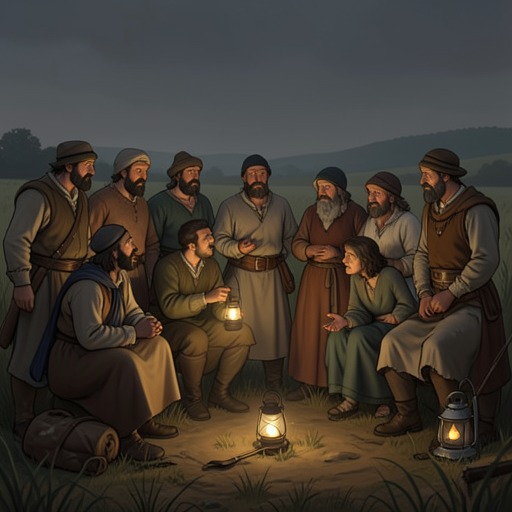
Lipce’s talk includes more than claims about neighbors. Rocho tells stories to groups gathered indoors: tales of kings, wars, enchanted places, and supernatural beings command attention, while listeners also contribute stories of ghosts, vampires, and other wonders. These accounts are presented as marvels and shared imaginings, not as reports about a neighbor’s private behavior. Their contrast with gossip clarifies the different work oral speech can do in the village: it can create a common imaginative world, or it can attach a contested claim to a living person.
Rocho’s story of a poor farmer and a wayward horse offers another form of spoken narrative. The farmer first tries kindness, then forces the horse to work; the animal remembers the treatment, kills him when the chance comes, and flees. The tale is a complete narrated sequence, unlike the fragmentary, revisable reports carried from cottage to cottage. The distinction matters: stories can be heard as stories, whereas gossip often acquires social consequences while its truth remains uncertain.
Even a material object can prompt this kind of uncertainty. When an iron rod is found and passed from hand to hand, villagers identify it as a tool for forging harrow teeth and speculate that it could have been stolen from Michał’s forge. Someone points out that the forge has been closed since Friday. The exchange records a possibility and a counter-detail, not proof of theft. Like Boryna’s suspicion about Jagna, it shows how the village interprets incomplete evidence through conversation. Gossip and social reputation take shape in that gap between what has been observed and what people are prepared to believe.